
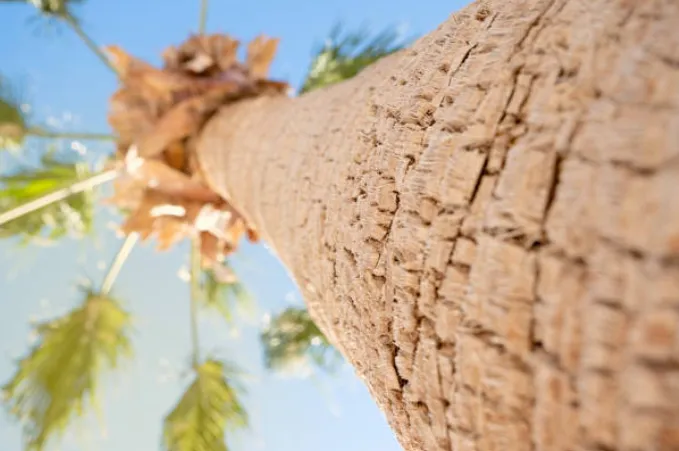
When a leaning palm is usually safe
Palms often lean on purpose. A palm planted near a building, fence or larger tree will grow towards the open sky, and over many years its trunk takes on a gentle lean or curve. A lean is more likely to be stable when:
- It has developed slowly over years, not weeks.
- The top of the trunk curves back upwards towards the light.
- The soil around the base is flat and firm, with no cracks or lifting.
- The crown is green and full, and the trunk is firm all the way down.
Even a stable lean is worth watching if the palm hangs over a roof, pool, driveway, neighbour’s yard or power line. Take a photo from the same spot every few months so you can see whether it is changing.
Warning signs a leaning palm could fall
Treat the palm as urgent if you notice any of these:
- A new or worsening lean, particularly after strong wind or heavy rain.
- Lifted, cracked or mounded soil on the side opposite the lean, which means the root ball is moving.
- Exposed, snapped or torn roots at the base.
- A crack, kink or split in the trunk, or a section that bends sharply rather than curving.
- A soft, hollow or rotting base, or fungus growing on the lower trunk.
- A brown, collapsing or missing crown, which points to a dead or dying palm.
- Movement you can see when the wind blows, at the base rather than just in the fronds.
Palms rely on a mass of fibrous roots rather than a deep taproot. Perth’s sandy soils drain quickly, but when they are saturated during winter storms they hold those roots less firmly, and the crown acts like a sail. That combination is why a palm that stood straight for years can suddenly lean after a front comes through.
What to do right now about a leaning palm
- Keep people, pets and cars clear of the area the palm could fall into, which is at least its full height in the direction of the lean.
- Stay away from power lines. If the palm is touching or leaning on lines, report it to Western Power straight away and do not go near it.
- Do not try to push, pull, prop or cut it yourself. A palm with a moving root ball can shift without warning, and palm trunks are heavy and behave unpredictably under a chainsaw.
- Take photos of the whole palm, the base and whatever it is leaning towards. They help us judge urgency, and you can add them to the quote form below.
- Call us. Hazardous palms are treated as priority jobs, and we aim to respond within 24 to 48 hours. See emergency and storm-damaged palm removal.
Your options for a leaning palm in Perth
What we recommend depends on why the palm is leaning, how big it is and what it could hit:
- Monitor it. For an old, stable lean with firm soil and a healthy trunk, the right answer is often to leave it and check it regularly. A palm health assessment gives you a clear baseline.
- Lighten the crown. Removing dead fronds, seed pods and flower stalks reduces weight at the top of the palm. See palm pruning and crown reduction.
- Straighten or move a young palm. A recently planted palm can sometimes be re-set and staked, and some smaller palms can be transplanted to a better spot.
- Remove it. When the root plate is failing, the trunk is damaged or the palm leans over a house, pool or power line, palm tree removal is the safe option. A leaning palm is dismantled from the top down in controlled sections, with each piece lowered by rope or rigging so nothing is dropped onto the structure below.
A mature palm generally cannot be pulled back upright. Forcing the trunk straight tears the roots that are holding it in the ground and can make it less stable, not more.
Leaning palm removal across Perth
Perth Palm Tree Removal Services assesses and removes leaning palms throughout the Perth metro area, from Joondalup and Wanneroo in the north to the coastal suburbs and the south. Every job starts with a free on-site assessment and a written quote, and every frond, trunk section and piece of green waste is taken away when the work is done.
Call (08) 7813 3802 and tell us which way the palm is leaning, roughly how tall it is and what is underneath it. If it is moving or resting on something, say so and we will prioritise it.
For everything else we do, see palm tree removal Perth and our other palm services.